Nothing To Fear Review


btas-nothingtofear6

By Andrew Kiess


Nothing to Fear is the third produced episode of Batman and premiered tenth on September 15, 1992. This episode was written by Henry Gilroy and Sean Catherine Derek, and was directed by Boyd Kirkland. It stared Kevin Conroy as Batman, Bob Hastings as Gordon, Clive Revill as Alfred, Robert Costanzo as Harvey Bullock, Mari Devon as Summer Gleeson, and Henry Pollic II as the Scarecrow.

I am fear incarnate. I am the terror of Gotham. I am the Scarecrow!

Nothing to Fear opens with an encounter between Dr. Long, a Gotham University professor, and Bruce Wayne. Dr. Long criticizes Wayne for failing to live up to his father’s name. While Summer Gleeson assures Bruce that Dr. Long was just blowing off steam because of a recent crime wave at the University, Bruce seems unconvinced, and is hurt by the comments. Later, he discovers the criminal responsible for the crimes, The Scarecrow, and attempts to put a stop to his reign of terror. However, Scarecrow has other plans in mind. Gassing Batman with his signature fear toxin, Batman begins to hallucinate about his greatest fear: failing his parents. Investigating the toxin, Bruce discovers the identity of Scarecrow to be a disgruntled professor of psychology, Dr. Jonathan Crane, and enters into his most personal battle yet.

I am vengeance. I am the night. I am Batman!

While the first two episodes of Batman had their bumps, Nothing to Fear is one of the series’ most iconic episodes. Most remember it for the quote above, this episode is the introduction of many of the elements that make Batman who he is. It is a succinct origin story wrapped around an exciting battle with one of Batman’s more unique adversaries. In many ways, this is Batman at its finest, and is the first of many to expand on the pathos of the characters that inhabit Gotham City.

Credit undoubtedly needs to go to director Boyd Kirkland, who would later go on to direct many fan favorite episodes, including Joker’s Favor, Joker’s Wild, Harley and Ivy, and It’s Never Too Late. Throughout many of Kirkland’s episodes, characters find themselves in positions that they normally would not face. Yes, this episode is “A Scarecrow episode”, but the real villain is Bruce’s insecurities, which is what makes it soar.


From a production stand point, Nothing to Fear is the first major success of Batman, and is the first in a long list of classic stories yet to be told. The camera work is precise and quick, the animation style continues the tradition of the Fleishcer 1940s Superman cartoons, and in many ways, emulates the look better than the episodes before it, particularly in the early scenes with Bruce and Dr. Long with the Art Deco design of the set. Overall, this is a classic episode and is what we as fans expect to see when we sit down to watch an episode Batman—quality storytelling, a compelling villain, and a hero overcoming obstacles in between him and the safety of the city and people he cares about.

First photo of Mera from Justice League

Warner Bros. Pictures has finally released our first look of Mera in the upcoming film Justice League! Mera who is played by the ever so talented Amber Heard is supporting a really awesome looking costume, which was designed by Michael Wilkinson!


mera-first-look-final-photo-720x720So what do you think of the new look? Like it? Love it? Hate it? Let us know in the comment section below.

Gotham Episode 3 Review

 Look Into My Eyes

Ahead of time I must apologize for the change in format. I have been down with a pretty bad flu of late and as a result had to hurry this on a bit. Gotham is off the hook for week 3 but I’ll be back in week 4 with all the honest praise and criticism the show deserves. Thanks for understanding.

At Sirens Nightclub, Jervis Tetch performs a hypnosis show to the audience. He selects a man of the audience to be his volunteer thanks to his guess regarding the man’s wealth. After performing the hypnosis on the man, he whispers something to him before freeing him. Barbara questions whether people can do anything he says to which Tetch explains, “Only things they secretly wish to do.” This was easily one of the best moments of the episode. The Mad Hatter is played excellently by Benedict Samuel. Thankfully we did not have to sit through an hour long “introduction/origin/explanation/justification” of his character. He’s introduced in the actual story by the events of the plot. That’s good storytelling, something many millennials have completely lost sight of. There’s a flawed call for “character development” which can be translated as “lazy explanations coupled with bad rehashing of exposition that ultimately wastes story time.” I don’t know what they taught you folks, but your sense of character development is insane. We don’t need prequels and solo films/series to develop one character. We just need a good writer.

On Wayne Manor, Bruce’s doppelganger reveals to Bruce and Alfred that he’s named “514A” but “5” to be short and that he awoke in Indian Hill over a year ago and they performed tests on him. So basically he’s the girl out of Stranger Things. Bruce decides to let him stay with them although Alfred is worried about him. Turns out Alfred is…drumroll…bum bum bum! Once again right! 5 learned to imitate Bruce, cut his hair and up and left! He completed the task he was created for! If it comes out of Indian Hill, let’s have a slumber party, cos that’s gonna end well. Having slept with Valerie (who THANK GOD goes away and actually does her job today) Gordon goes to the GCPD to collect his bounty. He runs into Lee (predictably) who was being offered by Barnes to return. She explains that she is moving permanently to Gotham with her fiancé, who is a doctor in head trauma in the Gotham General and she is seeing to join the GCPD again.

Tetch goes and kills the guy he hypnotized the night before with hypnosis. Already he’s more dangerous than his comic counterpart. Turns out his sister Alice (you smarties) has poisonous blood, which is why she hides from people and torches them if she accidentally infects them. The Mad Hatter wants Gordon to find her, so the price is hefty thanks to his new source of income.

Obviously the funniest part of the whole season, Mayor James announces to the press that he plans on continuing on his position as mayor. However, Cobblepot and his ubiquitous mob interrupts the press to criticize the “corrupt” system and Mayor James and announces that he will run for mayor in the new elections. Cobblepot’s campaign is pretty much something right off the Donald Trump show. It’s obvious but it’s also funny. Who said TV cannot reflect the hilarity of the times? MAKE GOTHAM SAFE AGAIN.

5 has Selina in a car by the way. Even though she notices how different “Bruce” appears. Just thought you should know.

Cobblepot displayed a moment worthy of Season 1. He met with the former mayor James in a café. And the mayor has 5 or so gunmen turn on Oswald the moment he gets snippy. Powerful, sure. Until the entire population of plain citizen eaters stand up and turn guns on the mayor and his paltry gunmen. What a fun moment to watch.

Tetch performs again in the Sirens but almost gets killed by Barbara when he hypnotizes her to believe he does not love her. “She has a problem with rejection.” Gordon confronts Tetch about Alice so he takes him to the rooftop to talk but Tetch hypnotizes Gordon and sends him to climb on the ledge to fall to his death. Alice arrives and stops him. Tetch tries to talk her down but she shoots him in the shoulder, causing Gordon to awake from the hypnosis. Alice saves him from falling from the roof, afterward, he handcuffs her. What a dirty rat. Turns out that guy Lee is fianceing is Mario Falcone. Mario honking Falcone. They have dinner with Carmine Friggin Falcone and he gives them his blessing. When you gotta leave Jim there’s always the HEIR APPARENT TO A STINKING GOTHAM MAFIA GROUP. Why’s Lee even back on this show anyway? She was supposed to be the doctor not Mario. We’ll see how this turns out. Usually not pretty.

The episode was better than the last one. Easily. Many of the problems they had through the first couple were either not there or played a very small part.

8.5/10

Gotham Episode 2 Review

Gotham: Burn the Witch Review

I’d like to note that these views and opinions are mine and mine alone and do not necessarily reflect those of Shanlian on Batman as a whole.

Given the fact that this is a DC Comics review article, I shall do the classy thing and stay out of politics. That said, I therefore have zero qualms about taking a little jab at last night’s WWE brawl. Never have I seen a presidential debate lack the word presidential as much as last night. Two corrupt people lying upon lies about things that the dumbest person on earth could Google and find the truth. For all of Clinton’s harping about her “fact-checker” website, she and Trump really could have used a reality fact-checker. I’ve never seen two people just stand there and pretend reality doesn’t exist, and they can say whatever they want and make it true. It was quite fittingly the pathetic show the loonies voted for in the primaries and a complete disgrace to this country.

In relation to Gotham, a conveniently timed storyline found its way into the episode: Penguin using his political standing to rile up a mob. And I’m not talking “let’s go protest something noisily” mob, I’m talking “let’s go kill Franenstein’s monster and any witches along the way” hence the Burn the Witch title. Read on to find out how that turned out.

The good news.

The Court avoided the usual villain cliché of stating their name and firing off on a cheesy speech. They just outplayed little baby Bruce and told him what they intend to keep: secrecy, and to be left the heck alone. Even though he should know nothing about the Court and never have spoken to them directly the writers backed themselves out of the corner—for now.

I’m proud that they also removed Jim from his crime-fighting always-righteous pedestal. He’s finally just Jim Gordon again. Not a Batman wannabe. In fact he’s pretty much thrown in the towel overall.

Alfred dancing. Enough said.

The GCPD actually (almost) handled a situation…professionally! Surround area, block press, negotiate for hostage. They’re in good hands when Jim Batman isn’t there to try and play Call of Duty hero and storm the building screw the consequences. The only reason things fell through for them was Penguin.

Penguin stirred up a mob to “kill the monsters” (Fish and her freaks) and walked right up to the building and pushed their way in. It was classic Penguin, and I’m happy to see he’s batting 1.000 in the power department. He’s finally using it consistently.

Poison Ivy’s transformation turned out to be more realistic (well, at least for Gotham) than several feminists in the entertainment media have been whining. She underwent a totally Joker-similar upheaval.

Bad news.

Penguin had Fish at gunpoint in the woods. Again. AND HE LET HER GO BECAUSE SHE LIED TO HIM AND INSULTED HIS EGO. Come on! She’s not that good at lying and he should have no second thoughts about blowing her to hell. The excuses the writers keep cooking up to keep her worthless, annoying, poorly played character on the show are getting too pathetic. It’s unforgiveable at this point. Unbelievable. Hey Oswald: #JUSTPULLTHETRIGGER

Vale’s sole purpose in this episode was not to be a reporter, but to cheat and a-hole her way into Jim Gordon’s pants. Sound crass? Of course. Is it true? Every word. Is it my fault? Nope. Watch closely: she is the star reporter of Gotham city, and all the work she does today does not add up to her story. If she were after Fish and Penguin for the story, she would have quit bugging the hell out of Gordon. Seriously, quit running to his doorstep and his favorite bar and the GCPD and his shower for crying out loud. Everywhere he goes she’s there wagging her tail with her tongue hanging out, waiting for him to throw her a bone (If you get that joke tweet me for a shout out). If she truly wanted to get a story, she would’ve followed Fish into the woods instead of selling out the story to TV networks and running back to Jim’s house like the annoying needy teen she seems to be. At best their relationship is a bad Adam Sandler rom com. At worst it is what it is: a would-be reporter obsessed with a former-glory cop who sacrifices a million dollars and her job to bang the guy she’s been treating like crap for the past two episodes (and he’s only returned the favor). She was abused, mishandled, and downright misused this week by the writers. What a lame, terrible way to get another girl for Jim. Good grief. (And on top of all that, Lee is coming back to Gotham just in time. Wonder if she dumped her guy or he dumped her. Who cares really. She’s going to walk in on this twisted, sick thing going on between Jim and the girl just like Barbara walked in on Jim and Lee).

The villain origins are completely cut and dry now. 1-Wake up. 2-Notice you’ve changed. 3-Kill the nearest person for little or no reason at all, usually simply because they did something inadvertently that happened to tick you off.

Honorable mention: Jim Gordon selling Fish Mooney out to Penguin in the hopes that he’d kill her. Jeez man, just sell her out, sneak up behind her, and capture her to take home the million bucks. Knucklehead.

All in all, we’re seeing good elements of a show. Action, suspense, acting (well, when Pinkett-Smith isn’t making us puke and Mazouz isn’t there at all). Conflict is usually solid. What brings this show down is the recycled shots of the bridge and buildings (they use them 3-5 times per episode) and the writing staff. One minute they introduce a good character and next freaking episode she’s Jim’s toy, behaving dreadfully, and throwing her life away. They gotta get a handle on this thing already. It’s too inconsistent. The writers really are the only thing hurting it though. Gotham has diamond in the rough episodes that are gorgeous (Penguin’s Umbrella, to name one) and when they come along each season they really reward the faithful follower. So keep watching guys, they’re coming. We’re getting payoff for their shortcomings soon enough.

Score 7/10

Gotham Season 3 EPS 1 Review

By

John McGee

For the first time in the three premieres Gotham has had, the story was moved forward more than it was stalling for setup.

Let’s start with the good news.

I got what I needed from Penguin—asserting his authoritative voice and realizing he’s on top, and no longer letting people push him around. He was magnificent in the opener.

Barbara Kean, ever the crazy lady, now runs a club with Theo Galavan’s sister (who happens to be one of those “dead” characters that the writers weren’t ACTUALLY willing to kill off—Theo ran her through with a sword last season and she’s living to tell the tale) and just let me tell you—Barbara is one sexy murderer.

Jim Gordon, after discovering that Lee has moved on to another man, has spent the last 6 months brooding in the Batcave and catching villains. Har har, but they still haven’t dialed up and answer for this major character problem they’ve let unravel. He’s doing Batman’s job and it doesn’t bother him one bit. It bothers me, though. Gordon was supposed to work his way up as a cop, through and through, not ascend the ranks in as little as a single season and get bored with the job after realizing he had all his goals. Now he’s a bounty hunter catching the escaped Arkham inmates from last season for the right price. Harvey Bullock is the only good detective left in Gotham. (Who would’ve thought that this “lackadaisical” man from the very first episode of the show would turn out the better detective and better man than Gordon in a mere 2 seasons? Jim is far too quick to judge character.)

Ms. Peabody is clearly Court of Owls.

Turns out Vicki Vale’s mother got an intro this episode, and look for her to be a major factor in this Season 3. Sadly the idea that Vicki got it all from her mom makes her less of a strong individual character, but thinking about the future doesn’t rob Vale Sr. of the present, which was quite strong indeed. Despite realizing later on that Fish Mooney was using her, Vale proved to be the mirror of the unease felt among Gotham’s citizens after the events of last season.

Selina is getting even better with age. Really growing up. She works with Fish Mooney (again) but mostly for the pay. After witnessing the would-be death of Ivy (here comes Sexy Ivy!!!) expect her to retaliate against Fish in her sneaky little ways.

Inevitably it is time for the bad news.

I guess I had it coming—I watched zero trailers or clips for Season 3, so I was holding out hope, probably foolishly, that they wouldn’t be so prevalent. Sadly, the Court of Owls is not only out in the open, but Bruce knows more than he should. Last time he played tough billionaire kid, he was nearly sacrificed. Now he’s playing tough billionaire kid again, and Alfred got another concussion and he’s been kidnapped. Yay.

I’m not too hot on the conflict It all centered on Fish Mooney. Sure, the monsters are a threat, but she’s being treated like this is the Falcone era. She should stay dead! Just because Pinkett-Smith can’t make a good movie or even just act well, it doesn’t mean that has to affect us by making us suffer through more of this character (and the “performance” behind it).

And David Mazouz, after watching Batman v Superman and Suicide Squad, has still learned nothing. He’s bringing zero maturation to the role of Bruce. He’s a little more calm and quiet, but still…just a whiny little whippersnapper.

All in all, it was a good start coupled with inevitable hiccups.

With this whole Court of Owls thing, I invite you to friendly debates @_DCWorldBatman2 but I don’t convince easily. DC Comics has unlimited, majestic potential that shouldn’t be squandered for dumbed down adaptations. The Court was supposed to be a secret organization that never revealed itself to anyone but its victims just before they killed them. Bruce was supposed to realize they didn’t exist, and instead they’re inviting him into their house. *facepalm* Come on! There’s no way a little extra effort in the writing department can’t do the Court better by their source material, which is something that would make Gotham infinitely better if it ever used any.

Newbies, I encourage you to binge Gotham if you haven’t already and watch Season 3. It’s still the most creative and cool show on TV. A great departure from the generic crime/comedy crap that plagues our screens today, even if I have some complaints about what it’s doing to source material (ignoring it) it’s still the best show on TV by far.

Score 8/10

Christmas With The Joker Review


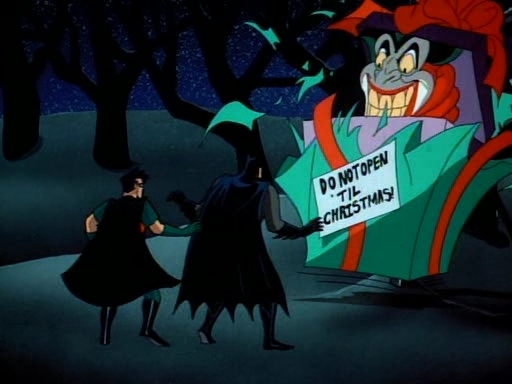
christmas-with-the-joker-batman-4673588-512-384

By

Andrew Kiess


Christmas With The Joker is the second produced episode of Batman The Animated Series, and was directed by Kent Butterworth and written by Eddie Gorodetsky. It starred Kevin Conroy as Batman, Lorem Lester as Robin, and Mark Hamill as The Joker. It originally aired as the 38th episode on November 13th, 1992.

In Christmas With The Joker, it’s Christmas Eve and the Joker, using a rocket disguised as a Christmas Tree, escapes Arkham Asylum. When settling down for a viewing of It’s A Wonderful Life, Bruce Wayne and his ward, Dick Grayson, are surprised to see that Joker has taken control of all the broadcast signals in Gotham City. Joker has kidnapped the “Awful Lawful Family” of Jim Gordon, Harvey Bullock, and Summer Gleeson, and publicly challenges the dynamic duo that if they do not find him by midnight, the trio will die. Searching for clues that the Joker has left behind, Batman and Robin spring into a chase across Gotham to find the clown, but Joker has a few tricks of his own (surprise!) to throw off our heroes.

Batman The Animated Series was still finding its stride when this episode went into production following On Leather Wings, but Christmas With The Joker is a fun change of pace for longtime fans of this series. This episode provides a unique, if not somewhat familiar tone. This episode’s claim to fame is being the first episode produced featuring The Joker (originally voiced by Tim Curry, but re-recorded to feature the voice of Mark Hamill) as well as the debut of Robin, but it’s the episode’s similarity to Joker’s debut in the Bill Dozier Batman series that stands out. In the two-part episode The Joker Is Wild/Batman is Riled, Joker escapes from prison via a booby-trapped catapult hidden in a base in the prison’s baseball diamond, similar to the hidden rocket he uses in Christmas With The Joker. Both episodes also feature Joker broadcasting a kidnapping over a pirated signal (which is, perhaps coincidentally, also featured in Scott Snyder’s Joker’s debut in the arc Death of the Family). The Animated Series is famous for its more dramatic leanings, but this episode is wildly entertaining, although it is not necessarily, as Batman says, “relentlessly cheerful”, as the Joker is out for blood.

Christmas With The Joker is the lone contribution to the series by both Butterworth and Gorodetsky. This most likely is the cause for its uncharacteristic tone, as well as some uncharacteristic artistic choices. The episode makes use of wider shots and larger “sets” than is typical for the series. The animation in this episode is also uncharacteristically subpar, as the movement is slower and choppier than what viewers expect from this series. This is obviously not the tone that Bruce Timm and company ultimately wanted, and the way that the episode plays on its own corniness may turn off some viewers. This episode also highlights in my eyes the necessity for this Joker to have a Harley Quinn to play off of, as it seems strangely wrong to see Joker play the lone wolf, but Mark Hamill’s presence always is elevating to the production as a whole, and Robin’s presence reminds me that Dick Grayson was underutilized in the series.

Overall, Christmas With The Joker is a fun episode that offers a throwback feel to longtime Batman fans, but is bogged down by the earliness of its production. Longtime fans can find enjoyment in it, while seeing the growing pains of a show that will soon begin to perform at a higher level.

On Leather Wings Review


batman_on_leather_wings

By

Andrew Kiss

1992. The DC Comics brand is in an identity crisis. The summer cast a shadow with the release of Batman Returns, a movie that remains divisive among fans to this day, and the death of Superman co-creator Joe Shuster at the age of 78. Knightfall is still a year away and Image Comics was making both DC and Marvel seem dated. I am only one-year-old, but little did I know that the most influential piece of my comic book background was also in its infancy.

This is the year that Batman: The Animated Series first shown its spotlight into the living rooms of fans. On September 6th, On Leather Wings, the pilot episode of the series was debuted (although, it was not the first episode to be aired. That distinction goes to The Cat and The Claw). This was the beginning of a change in superhero animation, which up until this point, was defined by Superfriends. But the creators of Batman looked deeper in the catalogue for influence.

Bruce Timm, the show’s primary artist, looked to Max Fleischer’s Superman technicolor cartoon from 1941. Although Superman is mostly remembered for giving the Man of Steel his power of flight (because Fleischer thought it too awkward to see Superman bouncing around too much), it was its unique style, created by the art of rotoscope animation, that caught Timm’s eye. It provided a unique look. For Batman’s unique look, Timm would draw Batman on black paper.

This creative decision provided a heaviness, and that heaviness is on display early in On Leather Wings. This episode tells the story of mad scientist who has turned into the villain known as Man-Bat. Man-Bat is committing crime across Gotham City, and the police force, of course, mistakes these crimes as being the product of Batman. Batman finds himself in a race with the police to catch Man-Bat, and, hopefully cure him, but with Detective Harvey Bullock leading a task force to capture him, Batman finds himself as both hunter and hunted.

Simply put, On Leather Wings is not the strongest episode of the series. But it has the elements of what will become arguably the greatest non-comic book version of the Dark Knight. The strengths of this episode shine brightly on the dark paper. The animation is beautiful, with the lighting and shadows creating a sense of dread, and at times, horror, at the 1950s style monster movie theme takes over the episode. This tone is intensified with our first taste of Shirley Walker’s complete orchestral score. Kevin Conroy’s first outing as Batman is also solid, providing some memorable moments, and is complemented by the unsung performance of the series, the late-great Bob Hastings as Commissioner Gordon. Where this episode fails is in the lackluster supporting cast of characters, with some hammy performances and uncharacteristic moments in the script, such as Man-Bat having a clichéd villain monologue before Batman (obviously) saves the day.

Even though this episode does not quite hit the ground running, the promise of what is to come is there. It will take a few more episodes, but this series will soon become the cornerstone to the DC Animated Universe that will carry through nearly the next two decades, introducing a generation of fans to the characters from the world of Batman and DC Comics. I am excited to start this ride over from the beginning, and am looking forward to continuing it with all of you.

Larson forges the Future of Batgirl

By

Rheanna Haaland


“You can’t see the future when the past is standing in your way,” Barbara Gordon muses from a rooftop in the latest issue of Hope Larson’s “Beyond Burnside.” Barbara “Babs” Gordon — Batgirl — may not have the biggest fanbase or the greatest backstory that DCEU has to offer (as Batman’s apprentice and Commissioner Gordon’s daughter). In the new series “Batgirl ” Eisner Award winning writer, Hope Larson continues to revitalize Batgirl as a character.  In the limited scope of past iterations like the unspeakable Joel Schumacher movies, Batgirl can easily come off as an ill-conceived attempt to unabashedly — and unsuccessfully — capture a  wider female audience.  Even her recent, better-developed-if-controversial role in Brian Azzarello’s animated adaptation of Alan Moore’s “The Killing Joke” leaves something to be desired. But Larson’s Batgirl is different. By allowing Batgirl to step out of Gotham, Larson and artist Rafael Albequerque let the audience look past previous versions of the character and actually care about this Batgirl’s future.


In “Beyond Burnside” Barbara embarks on a quest to meet an old, wheelchair-bound martial arts master Known as “The Fruit Bat.” When the Fruit Bat is assaulted by an assassin in a school girl uniform Babs wastes no time coming to the rescue. When the assassin escapes Batgirl is left with more questions than answers. She also serendipitously meets up with a childhood friend, Kai, who is mutually interested in being more than friends.

Externally, Larson’s Batgirl is a badass. She’s ditched the skin-tight latex suit  and high heels for a leather jacket and a pair of bright yellow logger boots. She knows karate and Ju Jitsu, she’s a detective, she fearlessly eats eyebals and octopus, and she speaks Japanese.  While that cool skill set and updated costume might be standard issue for any modern disciple of the Batman, those traits are only the Batgirl side of Batgirl. Larson’s version of Barbara Gordon may be a badass, but she’s also deeply, dynamically human. We watch her wonder if her attraction to Kai stems from the possibility that she will need to save him. The doubts she displays in her heartthrob’s ability to handle her — cape and all — strikes a chord with anyone who has ever wondered  “am I too much for this person?” And there is so much to Larson’s Barbara Gordon. She’s funny, she’s smart, and even in her semi-constant state of self-doubt, she is more than competent. She’s fun to read about.

We would be sorely remiss not to mention Rafael Albequerque’s contribution to “Batgirl: Rebirth.” Albequerque absolutely nails the pencils in each panel, which is by no means simply to say he can draw. Throughout the story whether Barbara is deep in thought, awkwardly flirting, or conflicted about lying to protect her identity, every one of her facial expressions is spot-on. And it doesn’t stop there; his depiction of combat sequences are spectacular. Some of the fights are so well-plotted that the reader is just as taken aback by the outcome as the fighters on the page.  Through his fabulously readable paneling, Albuquerque’s work enriches Larson’s story with a whole separate dimension.

Although it’s early to call Batgirl a full-fledged epic just yet, with such a loveable protagonist and such a excellent artwork, enthusiasts should definitely keep an eye on Batgirl, and on her creative team, for many issues to come. Barbara’s adventures in Asia are just starting.
The third installation of “Batgirl: Rebirth” hits newsstands on September 28th, 2016. Don’t miss it.  

OP ED: WHY I CANNOT CARE LESS ABOUT REVIEWS

By

John McGee

Movie critics have become more of an obligatory circus in recent years than a true gauge of the quality of film. Back in the good ole days critics were at best snobs who were “right” about half the time, even though they enjoyed tearing apart classics (Wizard of Oz, Fight Club, Scrooged, The Shining, Psycho…you get the picture). Critics have always viewed themselves as a godsend to their generation—“We’re the only ones smart enough and heavenly enough to know everything about every movie and declare whether it sucks or not.”

Well, ladies and gentlemen, I’m about to announce two insane facts about life. 1. Critics have gotten worse. Like the country, it’s just something you didn’t think could go further downhill until it surprises you. 2. Film. Is. SUBJECTIVE. WHAAAT?! I can’t watch trailers for movies and just say “It sucks?” Well if you’re one of those people, you’re well on your way to the film critic profession. Because not only have critics gotten worse, but they’ve become none other than average Internet bloggers who house great bias, vitriol, and generally don’t know any more about what makes a great film than a preschooler. And frankly they just don’t care anymore. They seem to believe it’s about power, and they want to use their “power” to dissuade people from watching movies they hate or simply try to make movies they hate look bad. It’s less about being honest and more about “what do we want this movie to look like?” “Did it live up to my condescending expectations?” “Was it made by people I like?” (I add that one, folks, due to the number of “professional critics” who took to Twitter days before Batman v Superman to announce that no matter how good the movie was, they’d never give a positive score to a Zack Snyder film. Now perhaps you begin to see the children we’re dealing with).

In fact, audiences are beginning to ignore the critics almost entirely. Batman v Superman received low reviews by pretty much all critics, but when fans and casual viewers are asked, we get numbers like 69% and even higher scores for the Director’s Cut that satisfied even some of the most disappointed viewers. Suicide Squad is lower on Rotten Tomatoes than Batman v Superman, yet the audience scores for Skwad are even higher than Batman v Superman. Suicide Squad is practically proof that critics don’t matter and their words are becoming as important to film as preschooler’s scribbles are to Monets or Van Gohs. 133+ million opening both here and overseas, coupled with a sustained first week that even Civil War and Batman v Superman couldn’t manage in their first week of box office. Audiences didn’t just come to the opening weekend shows, they spread the word and many of them went again.

Now let us examine what I believe is simple proof that critics have belittled themselves to the point of unimportance. Most of these bloggers (the irony here being that I am a blogger—but name one time I called out a film based on what I ate at the theater, or based on who made it. Thought so. Where was I?) These bloggers, when they run into a film they didn’t enjoy or pledged specifically to not enjoy use comparisons that run the gamut from “muddled plot and thinly written characters” to “DONALD TRUMP.” Yes, these are actual comparisons to the movie Suicide Squad. If I weren’t so jaded on the subject of modern critics I’d be shocked. How in the world do these “geniuses” and to quote the particularly worst one of them all, “the voice of our generation” fail to comprehend a plot as simple as Suicide Squad’s? A to B, break. B to C, fight. Flashbacks throughout to FURTHER EXPLAIN THINGS, and epic climax to resolution. Wow. That was so muddled. That filmmaker really hid things from us.

Another attack launched at the film when they ran out of other stupid things to say was that “sexism” reared its head. Not only am I now convinced they were in a completely different movie, but I’m angry. This was the least sexist superhero film EVER. DC Films takes tremendous pride in giving the female characters (often better than their male counterparts in many ways) their spotlight. Wonder Woman is the first attempt at a female superhero movie at all in the cinematic universes, but not only that. It’s merely the 4th DCEU film, and they’re already paying women to make the Wonder Woman movie, and based on interviews, Patty Jenkins knows more about the character’s nature and how this film works in 2017’s world than half the men working at DC. Marvel will burn through close to 20 films before making Captain Marvel (after ignoring Black Widow all these years) and what have Fox or Sony ever done for female characters? Suffice it to say DC is the least sexist of them all.

And calling a movie Donald Trump is like calling critics open minded. It’s a complete impossibility, a catastrophic paradox. It also just makes zero sense on paper. Clearly something it driving these critics against DC films, and it may be they enjoy sexist movies about superheroes more than they do ones that feature Wonder Woman, Harley Quinn, Enchantress, Lois Lane, Katana, and AMANDA FREAKING WALLER. That’s why I know these morons went to the wrong movie. You don’t walk away from Viola Davis’s Waller thinking “sexist.” She was the most powerful, smart, cunning woman I’ve seen on screen. She didn’t give a damn about what other people thought—she was herself and handled things and people the way she saw fit.

All in all, I’m not judging the people. There are some great critics left in the field (looking at you, Mark Hughes). But I am free to judge the actions of the loose cannons these people turn into when they grab their phone and vent their undeserved fury and flawed logic on a certain company’s superhero films. I do feel free to tell them that in subjective filmmaking they have zero right to judge films the way they do than the rest of us, no matter how smart they think they are. I condemn the way they try to judge subjective films, which are first and foremost art and should be viewed as such. Not as good/bad, but rather on the merits and what they try to accomplish in each film. DC Comics, say what you will about Warner Bros, are still making fairly artistic and sometimes excellent films. Let’s all take a step back and quit acting like this is politics and treat it like the mythology it is.

Marketing Key to Turning Tide at WB

By

Andrew Kiess

Here we are, three movies into Warner Bros’ superhero shared universe featuring characters from DC Comics. Remember when Man of Steel was controversial? It now looks like the one everyone liked. The online movie journalistic community seem to have set the DC movies in the crosshairs and are taking their shots. Suicide Squad, as of this writing, is 10 days into its release, and despite how many outlets are framing its financial situation, it has had an incredible ride to begin its journey at the box office, and much of that is owed to a terrific marketing campaign.

The DC Extended Universe three films in is leaps and bounds above where the Marvel Cinematic Universe was three films in. Marvel films accumulated $1,47.5 million three movies in and stumbled to reach the $500 million mark until the damn broke open when Avengers (the sixth movie in the MCU) broke the now watermark billion-dollar mark. It is no coincidence that Avengers was the first movie to make the mark. Yes, it had all the superheroes Marvel had showcased in one movie, but that alone would not be enough to get that many people to log into Fandango in the late spring of 2012, as Thor, Captain America: First Avenger, and The Incredible Hulk struggled at the worldwide box office and received mostly lukewarm reviews, and Iron Man 2, considered by some to be one of Marvel’s weakest entries, was the only film to surpass $600 million. So what changed? Avengers was the first Marvel film to be produced under Disney’s Buena Vista banner. Disney is far and away the strongest and most aggressive studio at marketing films.

Disney is historically manipulative to how films are advertised inside movie theaters. Disney is extraordinarily hands-on when it comes to trailer placement before films, poster placement inside theaters, and remain hands-on with what screens are showing their movies well into the film’s box office run. On top of that, they own both ABC and ESPN and use those spaces for TV spots aggressively and liberally. The trailers themselves are cinematic memes that follow a simple formula (dramatic landscape, character beat, action beat, humorous button) and create positivity to fans of their movies and characters. It’s familiar, and familiar is what folks respond to in marketing.

Warner Bros. have struggled, by and large, to market their movies. The marketing for Man of Steel was pedestrian, with TV spots and sponsored YouTube bumpers heating up within the final weeks leading up to release. Man of Steel did well at the box office, ending its time with $668 million. Batman v Superman’s marketing had an identity crisis. Where the first two trailers focused on the characters in what would be a philosophical approach to these icons of comic books, but the third trailer attempted to copy the Disney-Marvel formula, and in turn, marketed the movie as something it was not. Although Batman v Superman, in some ways, recovered, the third trailer in many ways revived the negative narrative surrounding the film the echoed through the critical assessment (not all of the negative reaction was because of the echoed negative narrative, but it certainly doesn’t help) and the film was perceived to have stumbled towards $872.7 million.

The marketing for Suicide Squad was a different animal. Not counting the Comic Con sneak-peek, the actual trailers, TV spots, posters, and all other marketing material carried a tone of a gritty, dirty, sexy, and grimy comic book movie about this group of villains trying to save the world. The marketing, to the best of its ability, sold the movie that was being put together by David Ayer and Warner Bros. (yes, I know about the editing controversy involving this movie, but that goes into the echoed negative narrative I mentioned earlier. The problems Suicide Squad faced in post-production was only news worthy because the movie was receiving a negative critical reaction. But any critical minded person who has ever bothered to study the behind the scenes elements of editing a movie would know that that kind of drama is not exclusive to Suicide Squad. Check out the documentaries on the extended editions of Lord of the Rings, if you don’t believe me). Whether or not people liked what the marketing sold in the end is a different story, but the consistency is hopefully a sign of good things to come.

Wonder Woman has a chance to be a new beginning for DC on film. A great first trailer is a great start. And yes, there will be a negative narrative hanging around this movie, and I would not be entirely surprised if that does not impact the critical reaction in some way. But just because some random person on the internet says that there is big trouble in little Themyscira, does not mean that it is time to panic. If the brothers Warner want to turn public opinion back in their favor, a steady and consistent hand in marketing Wonder Woman and then Justice League next year will be crucial. Until then, let’s all go back and watch Suicide Squad again and keep waving the flag for the movies we love.

All box office data taken from BoxOfficeMojo.com